Tuesday, November 10, 2009

XR0Y, TX3A


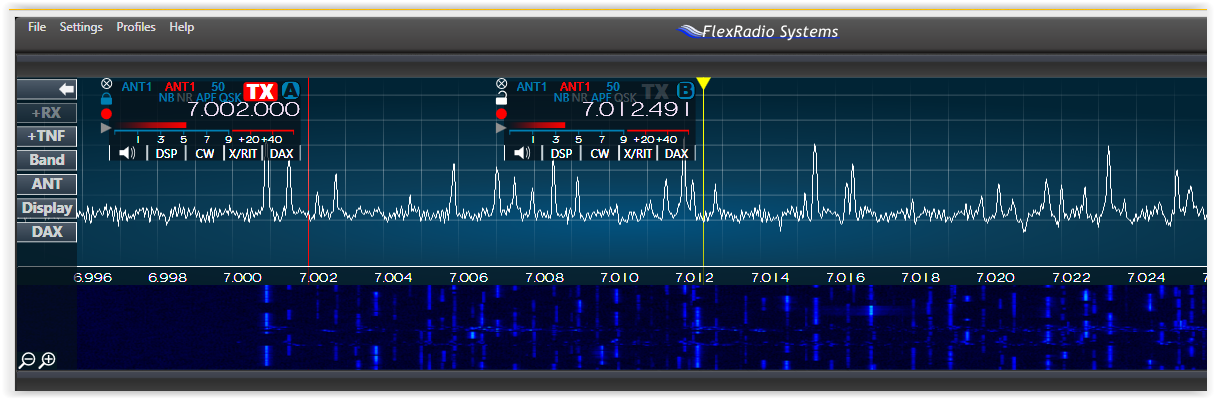
I was lurking around hoping to hear TX3A on some band beside 160. I've heard them on 80 once. As I was tuning 40 I saw this. The DX has the green arrow on his signal. Those callsigns show the limitations of skimmer as they are not CW stations and that 599 is not a 599 but merely what skimmer "copies". Its brains are not perfect but what it it displays for my analysis is super interesting. More on that as we proceed


This is a RTTY pileup on XR0Y down on Easter Island. I don't have any digital software hooked up at present but I thought it was interesting to see a RTTY pileup. I continued to tune around and eventually wound back up on 40 and this is what I saw


If you look at the signal below the green arrow you will see the mark and the space signal of XR0Y and in between the mark and the space there is a signal that looks like a check mark. This is what a signal looks like when it has chirp. This was a PU station having a QSO in between the mark and the space of the XR0 station!! He was running about s-4 (-107dBm or so). He was perfectly Q5 between the mark and the space. I had my filters set to 25hz. I have taken to just running 25hz all the time in the past few months. Between skimmer and the F5K it is a one click maneuver to get precisely on freq so even this bandwidth is no problem to tune.

Here is a closer look at this situation

I didn't make a recording, but this guy sounds like about half of the Cubans you have worked. This is what that sound looks like on Skimmer. Sometimes you get a double curly one down and one up so the element looks like ~

I worked ZL1AZE using 100W up on 80 while tuning around. He was very easy copy so the band should be well open to the TX3 on Chesterfield Is. They must be out for a nice leisurely dinner or making a beer run out to the boat, because the gray line flew over their heads 45 minutes ago and I don't see a peep on any band and people on the cluster are begging them to get on the air. Well I can grab another hour of zzz time so I guess I'll sign off for now....

As if on cue there he was on 3521 very Q5. He was running Japanese stations. Once I figured out his split, he was in the log. I would still like to pick him up on 40 sometime, but I guess he will be there till December

One last horrifying screen shot

This is a shot from skimmer with the click filter turned off. This is what our "modern" transceivers look like on CW Broad as a barn door. The above RTTY shots and the shot of the PU station were also taken with the click filter OFF. Next time you look down your nose at some poor joker out in the Brazilian bush with his chirpy little signal you might wonder exactly what kind of signal YOU are putting out.

73

Wednesday, November 4, 2009

TX3A


Mucho 160M big iron rolled out of bed early this morning to work TX3A. I could just hear due to low noise conditions here in FL (FINALLY!!!!!). Here is Chesterton on a map


I'm the little black dot in FL He is the little blue dot off east Australia. We usually have pretty good propagation to Australia so this might be do-able for me. If I had some gray line time this morning it might be do-able, as he is building nicely but alas I have to go.

In the mean time I worked KH2L in Guam up on 40. He was LOUD LOUD LOUD Here is a map of Guam for comparison:

You can see him a thousand miles up the ocean. Did I say he was loud?

Good times

73

Saturday, October 31, 2009

Pass the COM ports please

I recently built a new computer for my ham station and installed plain vanilla Windows XP 32 bit O/S. If you're interested I have a blog entry on the new machine, and best as I can tell it's completely compatible with the F5K and PSDR, fast and stable. This computer has been running swimmingly without a hick-up 24/7 for a few weeks now. It is an architecture that has eliminated many of the old ports like the PS-2 ports for mouse and keyboard and it has NO com ports and NO parallel port. There is a header on the MB to add some kind of PS2 ports but there is no cut out on the case to install such.

No problem I just switched to a USB keyboard. I had one that I use to trouble shoot computers but its a bit to small for comfortable typing so I went in search of a USB keyboard that made me happy. Here is what I bought:


All of my laptops are Thinkpads and I love the keyboards and this thing is nice sized. This is just a Thinkpad keyboard that is put in a little plastic case complete with mouse and hooked up to a USB feed. For years I used an IBM server keyboard because it had the IBM feel but was small. I don't need number pad sized keyboards sucking up my desk space. This keyboard has a nice palm rest and and that little eraser mouse which is OK with me, I also have a regular mini AOPEN O-35M mouse plugged in another USB port which is what I mostly use. That mouse is on the smaller side so it also saves a few cm^2 of desk space. I can highly recommend the lenovo keyboard if you are in the market for a USB keyboard

Now to the issue of COM ports: I don't got any!!!

My winkeyer USB uses a usb port. I upgraded from the serial port version just for this reason. PSDR allows you to key the program from an external keyer using a serial port, and I have used that as my first choice for CW keying for many years now. I have a paddle plugged into the F5K directly, but I almost always use my favorite paddle and my winkeyer. I have a special little pushbutton block of 4 buttons I had Pierro Begali make for me years ago and I have that wired into the winkeyer so it makes for a nice easy memory keyer setup. Now my first glitch: How do I get a physical serial input so I can input the output from my keyer? I made a little adapter using a PNP transistor and a resistor on a 9 pin plug that plugs into a serial port that allows me to plug in my keyer and key PSDR, but I have always used it with a regular serial port. I had a USB to serial converter laying around so I installed that and plugged in my adapter and set up PSDR to read that port and voila' it works!!! So that part is done. Next I have a bunch of other programs that need virtual serial ports to interconnect. I use DXlab suite and I use Skimmer and I sometimes use N1MM and sometimes fool around with the dreaded "digital" programs, so I need at least 4 virtual COM ports available.

Up to now I have used VCOM for this duty, but VCOM is kind of buggy. There were two guys sitting on a porch rocking. Every so often a hound dog next to one guy would raise up and go OOOWWWWWWW. After a while the other guy said "why is that dog doing that?" The first guy said "because he's laying on a nail". The second said "why don't he move" and the first said "it don't hurt enough yet".... that was my relationship with VCOM. I would get BSOD with VCOM even with XP 32 bit, but it wasn't enough of a hassle to change. There are a couple of other alternatives but each had its show stopper for me so I just plodded along with VCOM. VCOM is no longer supported by its author, the formidable N8VB who has gone on Quicksilver SDR fame. As far as I know it only supports XP 32 bit so if you are more exotic than that as far as VCOM is concerned you're out of luck

I read on the Flex list that Steve Nance K5FR (also quite formidable) has created a virtual port program using the Eltima V.S.P.D. 6.9 serial driver. This is probably the best windows based virtual port driver out there and supports all versions of windows from 2000 onward. Suddenly the nail hurt wayyy to much. I downloaded the driver from this website. I had previously un-installed VCOM and rebooted. I installed this driver and rebooted just like it tells you in the instructions.

I then opened the configuration program and here is what I saw:


I proceeded to add some ports (since that is what this is all about) and low and behold:

I have serial ports out the ying yang. I always number my pairs such that 10 is added to the lowest number eg 6,16, 7,17 etc. This program recognized my naming pattern and all I had to do to add ports was push the friggin button. It was so easy and that damn nail is not hurting me anymore.

Steve of course is the author of DDUTIL a program without which my ham radio experience would be far less rich. If you're in need of ports get off the nail and give this program a spin. Slicker 'n mucopolysachrides (aka snot)

73

P29VLR

This morning I'm sitting at the radio. It's 8:30 and I've been here for about an hour or an hour and a half. I have the head phones on and I'm reading the mail on a couple of guys down on 40CW while I'm checking email and reading the Flex list, checking Drudge etc. I pretty much just get my news from Drudge anymore since the rest of the media is basically out to lunch and at least if the world blows up Drudge will put a couple of spinning bubble gum machines and give you the head line

WORLD BLOWS UP!!!!

Fortunately I did not read that headline rather it was about all the movie stars that are sucking up to Obama. Guess that means I'll live through the day. I glance over at the panadapter on PSDR and here is what I see


Pile ups are very distinctive in their appearance. You can see all the stations in the middle of the screen piled up on each other. When this started it was just three or four really loud stations calling the P29 all basically on the same frequency. I'm thinking what the heck is this???? It almost looked like some kind of weird new multi channel digital signal like Olivia or something because it was a bunch of signals in a tiny little bandwidth. It's 8:30, the DX is usually well down into the sun noise by now, the gray line has moved on to New Orleans and the best I'm gonna do as far as DX goes is call Chicago. Now I like Chicago. I'm from Chicago, but as far as DX goes Chicago ain't it.

I flip down to this "pile of signals" and try to find the DX and loud as heck is P29VLR working the pile. With Skimmer I quickly determine where he is listening. He is moving up the pile working the next station in line he can hear, and then moving on up the pile to the next station 100hz up or what ever. I check the bandswitch on my AL80B and its set to 40M. I flip on the amp. I use a AL80B on most of my contacts because I can just flip it on and be ready to transmit if the amp is all tuned up. I put myself in his line of movement and BANG he's in the log. I look over at the SpotCollector (my DX cluster program from DXlab) and he is just now showing up on the cluster and I already have him in the log. In a couple of minutes I see that station spotted on 80M but I am way too far past gray line for that QSO. The guys in Texas have a shot at that one, but FL is dead meat. I then see a DU9 and a KH0 spotted on 40, but by now its 9 am and the sun owns my receiver as far as propagation goes and its time to go call CQ Chicago. Pretty soon I won't be able to even hear Chicago. HMMM if I had a remote base Flex station in California I could still get in on the fun.....

I check QRZ.com for some dope on P29LVR. P29VLR is operational on New Guinea for only a few days from Oct 27-31. It is now their evening on the 31st, probably just a couple hours from pull the plug time. Were it not for the F5K and its panadapter I doubt I would have even noticed

73

Friday, October 23, 2009

DU9/DL5SDF


Heard him peaking at -107dBm. He heard me not at all. This receiver is amazing!

73

Wednesday, October 21, 2009

Fiji at 4:30


I went to bed early last night since I was beat from a long day. That meant I awoke early. Usually I just try to roll over and get another hour or so but this morning I was awake so I got up stopped by the fridge to scarf a bite of chicken from some left over panang curry. I hit the mouse to wake up my computer, and when the screen lit up I was on 160, and there was 3D2KJ calling CQ.

He was about S4 (-100dBm) and my band noise this morning was a pleasant -115dBm, with the usual deep long cycling QSB of 160. I tuned up the AL80B on 160 and gave him a call. I have other more powerful amps in my shack, but 99% of my work is done with this AL80B I bought 20 years ago. There are 2 reasons. First it puts out a solid KW and second it's instant on and the tuning is absolutely reliable. I fitted a clear plastic page protector to the front panel and that has little arrows pasted on it that gives me a place to tune to for each band. I just set the dials, do a quick dip of the plate and check the grid current and I am ready to go. Ten seconds tops. With my other amps it takes 3 minutes to condition the cathode and all of that, then you gotta tune and then make sure you don't draw too much grid current bla bla bla. By the time I get the amp tuned the DX has left the building. In a pinch that extra few dB can make all the difference, but if I could have just one amp this little AL-80B is a near perfect ham radio amp.

I've been looking at the new Ameritron ALS-1300 to add to the line up. First, IT ISN'T TEN FREAKIN' THOUSAND DOLLARS!! Second it puts out 1200W. Third, it's instant on and it can be made to be band following with the F5K and DDUTIL. This pretty much would make DXing a one click operation. Click on the station and the correct antenna is chosen the correct setting on the amp etc etc. Sounds lazy I know, BUT that would allow me to use my F5K from anywhere in the world, including as a mobile when hooked up to the iPHONE. I'm not quite sure how I would send CW with an iPHONE BUT.... Always something new to fool around with in Ham radio, but I digress.

The 3D2 was working up 2 and working single callers. No pileup at all. In fact hardly any takers. He would sit there and call CQ maybe half a dozen times between contacts. I sent my call sign twice and he came right back. With the spicy after taste of panang still tickling my senses we exchanged our info and I plugged him in the log. This is the kind of stuff you dream about. Flipping on the radio and popping Fiji on 160 first call... No big wall of the west coast to penetrate. No big wall of Japan to penetrate. Just 2 hams mano a mano against propagation and that ever present deep fading of 160. I checked the lightning map and FINALLY there are no red dots out in the Atlantic or in the Gulf. Just a couple dots in Kansas and one lone dot in west Texas. As I sat here typing this, Fiji got bored and shut down about 5:15 Strong signal, low static, excellent operator, and no takers, too bad. The second and third tier could have picked off a juicy one this morning. The east coast slept and my insomnia payed off. Now I'm dreaming of my Latte...

73

Monday, October 19, 2009

TX5SPM/FO-M, K4M/KH4


The static at my QTH has been absolutely horrible. Its still bad this morning,but not as bad as the past few days. I got up a little early to spend a few minutes in front of the rig, sip some latte and hear what I could hear. I worked K4M on midway on 30M this morning. He was strong here. It was a strange sensation watching Skimmer as I could see virtually no one calling him, yet his rate indicated he was hearing a nice sized pile up. I could hear K4M on 40 and 80 as well, nice signals. Here is the reason I didn't work them this morning on 160


The 160 Titanex bit the dust.

I worked TX5SPM on the Marquesas Archipelago on 40M. It is such a pleasure to work a DX station that knows how to operate. All of the operators I have worked at K4M and the two TX5 expeditions have been top notch. Unlike those morons out on Glorioso a couple weeks ago. What is the point in spending all that effort in order to do a crappy job?

I did tune down to 160 and heard 3D3KJ on Fiji. He was super weak, barely copyable, and there were a scant few calling him, people with better stations than mine!! With all this Atlantic static I have bee strongly daydreaming about putting up some kind of directional receiving array. Given where my main transmitting vertical is located it would have to be in the front yard and I don't think the wife would be too amenable to that, but we will see.

Here is a shot of the static sources this morning


Nothing across the entire nation except in my skip zone off my east coast!!!

Over the weekend I worked a guy running a home brew 6L6 rig. It brought back memories of 50 years ago when the bands were full of chirpy drifty little rigs running 20 to 50W. Not to complain about my contacts transmitter quality at all, but as I worked these stations this morning I remember my S-40B receiver that covered the entire 40M band in about 5/8 of an inch of dial space, and a Q multiplier for filtering. On that radio I ran the volume wide open and adjusted signal strength using the RF gain, much like I do now with the F5K. To make these contacts this morning I had the filter cranked down to 25hz. At that bandwidth a few hz off freq makes the difference between Q5 and no copy. If you ever wonder at the strides we've made over the past 50 years in ham radio, and you were around in those days its amazing to think of what we are able to do. All of these DX stations are rock solid and do not move. Once I get on freq I can forget about tuning. One of the K4M transmitters is consistently about 10hz low, this is how far we have come. My little 6L6 buddy made me open the filters up to a khz or he would have drifted completely out of my pass band with every transmission. 25hz filters, and being able to track a stations freq down to a hz so using a 25 hz filter is possible that is simply amazing!!

I had a recent correspondence with some one who was carping about DDS. I had written about the recent review of the F3K in QST and about how the people they choose to do the SDR reviews know basically nothing about this kind of radio. The reviewer stated that SR (spur reduction) does nothing. He then proceeded to describe that when he pushed the button that the any spur he had in his pass band moved OUT of his pass band. This is what spur reduction does it moves spurs out of the pass band. So basically the radio was performing perfectly and the reviewer was too naive to even understand what the radio was doing. In my retort I asked rhetorically what other radio allows you to move spurs out of the pass band? I got a response that the K3 does because the K3 also uses a DDS and the comment was this was somehow a backward movement in VFO development. The reason I can have 25 hz filters and talk to stations that have enough stability to use this kind of narrow bandwidth is precisely because of this kind of DDS technology. So the next time you hear some guy quacking drearily about his 75A4 and how it's "as good as" think about what it takes to make a QSO using 25hz filters.

73