Saturday, February 21, 2015

Contesting Revisited ARRL DX CW

The ARRL CW International DX contest is on the air!

I'm not a big contester but Flex is slowly honing its contest chops.  I mostly play around in this kind of contest to look for new DXCC contacts.  Recently on EHAM there was a discussion regarding light weight rigs to take on DX pedition.  I made a little argument for the Flex 6300.  It weighs 10 lbs and is 11.75" x 13" x 3.875".


It's only 1.5 lb heavier than the TS 480.  I also use a Samlex SEC-1223 power supply which is very quiet RF hash-wise, is 8.19" x 7.28" x 2.4" and weighs 3.5 lbs.


The radio puts out 100W and has a very wide range tuner in terms of matching capability.  The real power of the radio of course is its software and its ability to interface with 3rd party software.  I decided to showcase the ARRL contest since this is a high RF, high station count environment similar to a DX pedition.  Here is my contest setup for this contest 


I purposely set this up so it would all fit on one screen like you would have using a laptop in a DXpedition situation.  To run this I am using SmartSDR which is the "radio/panadapter/waterfall box.  Next to the radio is CW Skimmer, and next to the Skimmer is WriteLogs bandmap.  The bandmap is entirely populated by Skimmer decoded signals, in other words signals strictly taken from my antenna.  I do not have a cluster client active.  Here is a closer look at the skimmer bandmap combo:


Writelog is set up to color DX stations differently from US stations in this contest.  As you work stations the colors change so you can tell at a glance what has already been worked.  Skimmer is not a perfect decoder but it does a pretty good job.  You have to confirm everything by ear.  My logging program is Writelog 


One of the concerns was related to constantly clicking windows.  Flex has addressed this issue by incorporating an auto focus feature in SmartSDR


What the hell does that mean??  It means that when you click off of writelog to say the panadapter or the waterfall or Skimmer or the bandmap, the focus automatically returns to the Writelog data entry line 100 ms later.  In this shot I am clicking the waterfall in SSDR


Notice how the bottom of the SSDR screen is highlighted.  100ms after I release the click this happens


Notice how the bottom of SSDR is covered by Writelog which is now in focus and how the black cursor in the data entry line is flashing ready for entry.  I also use the FlexControl 


to tune the radio.  The Flex control is always connected to the radio and is focus independent.  

These programs do not use CAT to communicate.  The 6300 (the actual box) is a server.  It connects to the computer via a GB ethernet port.  As a server it can connect to several independent clients on the computer.  One client is the SSDR software we see on the screen.  Another client is SDR-Bridge written by Ed W2RF


This is a piece of free software that integrates other software like Writelog, Skimmer, the ve7cc cluster client into a single set of components and presents that integrated data to the 6300 as an independent client apart from SSDR.  

A third client I use is DDUTIL V3 written by Steve K5FR.   This software integrates the rest of the station to the 6300 like amps, watt meters, steppir antennas, rotors etc.  It also automatically will set drive levels for up to 2 amps and provides a interface for the FlexControl.  It also acts as a relay station such that you can connect several CAT based programs to the Flex system.  Suffice it to say the scope of these pieces of software outstrip the intent of this blog post.   

Skimmer, Writelog and ve7cc interface to SDR-Bridge over a telnet loop bypassing CAT commands, so the system is CAT independent and therefore extremely reliable and extremely fast and extremely customizable.  

Here is an example:
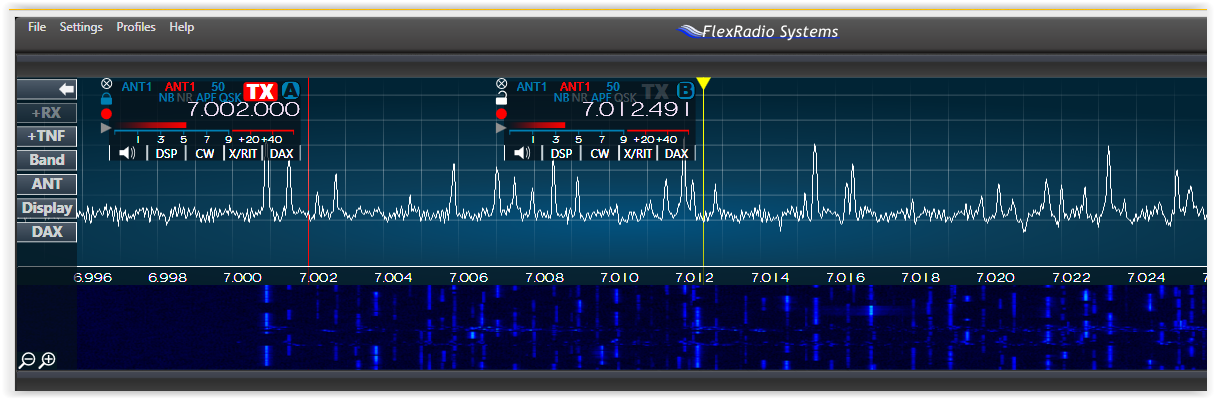

Let's say you're the DX on 7.002.  You don't want that freq to move so you lock VFO A and and set it to be the transmit VFO.  VFO B then is your receiver VFO.  You can tune this by clicking callsigns on the bandmap or by clicking callsigns on skimmer or by tuning the FlexControl as you would with a regular radio, or you can grab the yellow flag in VFO B and make a big excursion if desired.  If you click skimmer or the band map the decoded info is automatically loaded into writelog.  As soon as you let go of a click the focus snaps back to the data entry point in writelog and you can enter data.  There is no mad clicking between programs and it is very smooth to use.  


In this shot I have the 2 VFO's in the upper panadapter which is set for moderate granularity of 2 khz per division so things are nicely spaced out.  In the second panadapter the entire involved spectrum is displayed so those Tromelin style pileups can be watched from top to bottom.  In addition you can watch the DQRM on your transmit freq and make adjustments.  You have a complete view of what is going on while you continue t make contacts.  What about calling for EU in the face of a wall of NA or vis versa?  Skimmer and band map make it easy to find stations in specific regions.

One of the requirements was low cable count this set up has a power cord, headphones, mic, key and coax/antenna.  You can add a winkey if you like.  The radio allows a seperate RX antenna as in beverages or other exotic antennas for low bands as well.  If you want digital like RTTY simply fire up the client of your choice.  The 6300 has software audio to send TX and RX audio signals (called DAX for digital audio exchange) between the radio and your digital client and the control data for the client like freq and PTT are over software serial cables.  

You of course can use as much or as little of this as you like.  If your a troglodyte and its just your knob and your key and a paper log then the radio will do that in spades.  It's up to you to design your experience.  This is but one possible deployment.  There are other possibilities as well.  The latest version of SSDR is very easy on computer clicks.  I run an intel plain vanilla 65w i7 using onboard 4600 graphics and can run up to 3 monitors.  A reasonable laptop would run this FB  Here is how stressed my system is with everything running plus wifi and browser


In other words you don't need a workstation to run this system by any means

73  W9OY


Tuesday, May 24, 2011

PP0T Trinadade & Martin Vaz

This morning I couldn't sleep so I decided to brave the static and flipped on the radio. The static was out of OK and AR this morning


I saw the expedition on Trinidade spotted on 40 and decided to give a listen.


He was in the mud until I got diversity adjusted and then he was Q5 but still with a lot of static and QSB typical of summer time conditions. He was working one-zeez and two-zeez up one mostly EU. Here are the stats and location for Trinadade


It's about 4700 miles SE. Here is a google shot of the island


The pics shot off and around the island are stunning and worth the google trip. A little after I worked him he QRT'd and I was hoping he might show up down on 80M so I hung around for a bit to write this blog post and see what might develop, but no such luck. Trinadade has an interesting history and you can read more on the PP0T web site

There is only one op on this expedition as his transport was a Brazilian Navy ship and it headed out at the end of April to return in June. Pretty exciting to contemplate operating from a place like this for a month or more


73

Monday, April 25, 2011

FJ/OH2YL


I've been off the radio for a few weeks and flipped on 80M and there was FJ/OH2YL Anne is on DX pedition on St Barts operating 160-10 CW

She was an easy chip shot from FL


When I first heard her she was working the gray line across EU and Russia. According to the web site she is running a pair of phased HF-2V butternut verticals. She was probably beaming EU as her strength was such that I probably worked her off the side of her array


She was in direct competition with the storms over Louisiana. The storms are about -95dBm, summer time cdx are certainly here.

I flipped on diversity and was able to null the static down to about -102 dBm making the listening much more pleasant.


I listened to her knock off station after station as I wrote this post. She is one fine operator. Wish she would QSY to 40 :)

73

Sunday, April 10, 2011

The Amazing World of Ham Radio


So no sooner did I write about the "Knob Project" than did I start to receive email from others who have been involved in developing similar ideas.

James KS4JU editor of HamRadioScience wrote about development of computer cases with built in screens


His comment is that some of these cases also contain remote controllers


I can see the brain flashes going off all over radio land!!!

This morning before I even got my Latte I got a note from Tobias DH1TW about his project


This guy has developed a complete control surface for PSDR using a DJ console that is in Beta testing!!

I haven't had the chance to review either of these developments in detail, but I think its GREAT!! It shows the versitility of a plastic radio, that is a radio that can be molded by the user to fit the user's needs. In my case I wanted a radio station that was highly integrated. I wanted a radio station that would do my will and follow my needs without my having to do much in the way of knob twisting and button pushing. I wanted a radio station with a high degree of efficiency and I had a blast creating that all based around PSDR and DDUTIL. To acheive my goal I needed this

A 19 dollar board from Unified Microsystems and the support of K5FR and DDUTIL

I also wanted to try to bring to ham radio the promise of SO2R based in software as an extension of the automated station, and to a very large extent we have created this also using N1MM as the contest interface.

James is interested in a radio in a box kind of approach YET the radio looses none of its flexibility. It gives up nothing but gains in its individual expression of character. On the other end I have seen PSDR displayed on 40 inch TV screens at the Orlando hamfest


A few of us got together and built a Knob


as a foray into a different means of control for use in contesting and DXing, and the Knob was turned into a commercial product

And now other hams from around the world are revealing their own additions and variations and ingenuity!! What fun this hobby is!!

73


Friday, April 8, 2011

The Knob becomes a FlexControl

Flex is announcing a commercial version of the Knob by K6TU and K6TD. Here is a recap on Stu's website regarding bringing this product to market

Contest Knob – Announcing the Product

I didn't really have anything to do with bringing this concept to market except for my input in helping design how the Knob does its "Control" thing, which I think it does VERY WELL. For $129.95 the "Flexibility" this device brings to the radio is well worth it. It is much much more than a contest controler, but makes a whole panoply of features readily available to the finger tips.

The argument has always been either/or. EITHER it's point and shoot OR it's a Knob that is needed. This device makes it BOTH/AND since it is seamlessly integrated into the operation of the radio. Its presence brings a whole new level of integration to managing the radio, and in my operation it has become indispensable. It was a lot of fun being involved in this project, and it shows once again the ingenuity of hams in solving their own problems and in coming together to devise a "corporate" solution. Corporate comes from the Latin: corporātus which means to "form into a body" and that is what happened. Many came together to create something useful for all involved.

I haven't had the chance to give the commercial version a whirl, but given what I know of the prototype, I would not hesitate for a second to recommend it to anyone who is interested.

73

Tuesday, March 29, 2011

More Knob

Origins & Refinement of the Contest Knob - II

Stu continues with part 2 of his recap of the development of this fine contraption. Just for the record I am never satisfied but I am willing to be bounded :)

73

Sunday, March 27, 2011

4K8M UN3F


I was doing a little correspondence when UN3F in Kazakhstan popped up on 30M. Recently I have increased my 30M operating. I am usually on 40, 80 and 160 and had only worked about 100 countries on 30M till about a month ago, so I have been trying to pick things up on 30 since not too much new in the way of spots comes across the cluster for the other bands. I could do a lot more on 160 but my antennas are still down on that band.

Just as I tuned him in he was working a WB8 and I was getting set to work him and he seemed to disappear, probably going QRT. He was past his sunrise so he was probably heading out to work. At the same time I saw 4K8M in Azerbaijan spotted so I loaded up the memories and had at it, clicking back and forth.

Unfortunately UF3F was truly gone but I had 4k8M in the log first call.


I have 3 antennas available for 30M and none of them are great. I have a 135ft flat top at about 50 ft fed with open wire to a Johnson KW matchbox. That antenna has as pattern that looks like this on 30M (north is strait up)


This antenna was not a very good match for UN3F but a better match for 4K8M

The second antenna is my 65ft 80M vertical. On 30M this antenna approximates a 5/8 wave vertical. This antenna has an extensive radial system and exhibits a SWR of about 2:1 on 30M. I better match that with an Ameritron tuner. This is the antenna I use the most on 30M


Finally I have a 45 ft vertical wire out of a tree that has a MFJ 929 auto tuner at the base of the tree. It has a beautiful pattern:


unfortunately the ground system on this antenna is abysmal since I mostly use it as a RX probe antenna for diversity, so I don't transmit on it much. UN3F is on fairly often so I'm sure I will have another shot at him before summer

73

Saturday, March 26, 2011

Filters


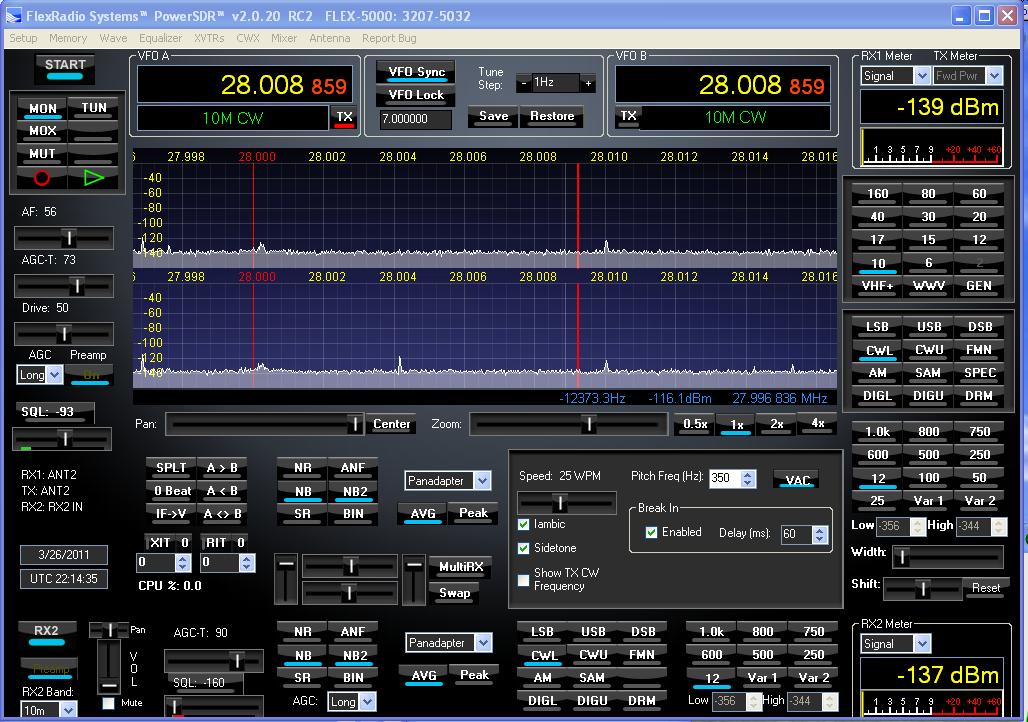
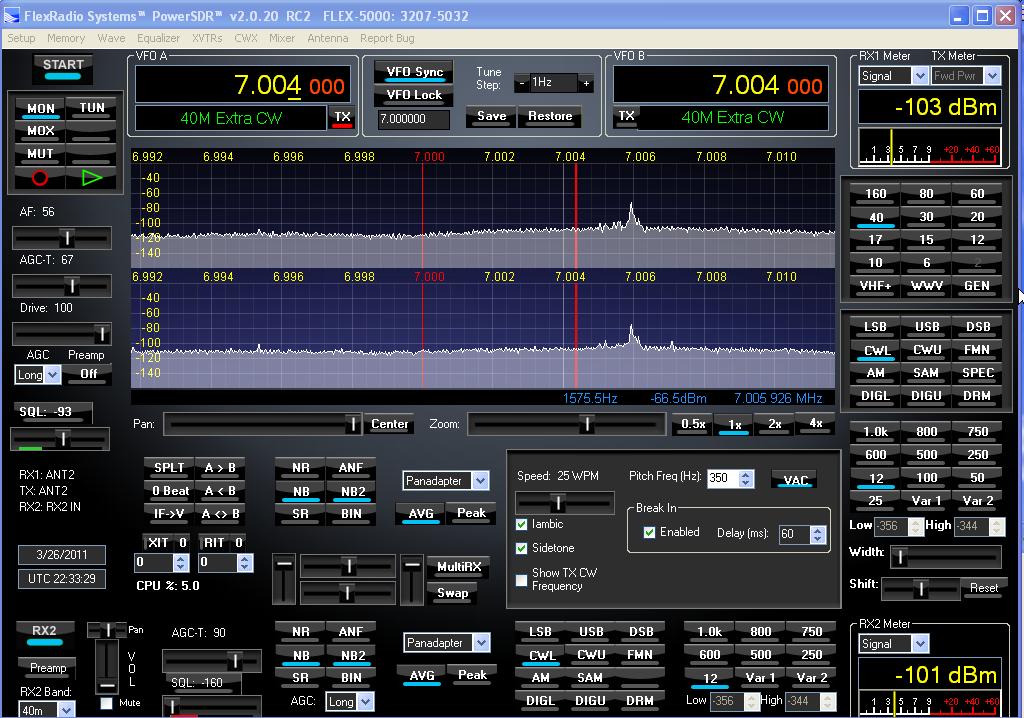
My old buddy K3RR and I were corresponding and he mentioned the difference between his cascaded 250hz filters and my 12hz DSP filters. The theoretical difference is 10log 250/12 =13.2 dBm. I was sitting on 80M seeing if I could hear anything out of A52J:

(after all hope springs eternal) and since the band was so quiet I decided to measure the difference and make a little document.

Here is the radio with 12hz filters:


The RX2 receiver's vertical antenna has a little less output than the full size vertical on 80M connected to RX1. Best case today is in the -118dB range. For the 250hz case:


-107 dBm was the best I could do which is about 11 dBm difference. So the filter difference extends me another 11 dB into the noise floor. I decided to look at 500hz filters as well:


Predicted is 16.2 dBm and I got 14dBm difference, very consistent with the data point above. Some of the difference between predicted and measured could be due to AGC action since certainly by the time I get 16dB above the noise there is some AGC starting to flatten out the signal. I had "best" AGC-T (agc threshold, or the point at which the AGC just starts to reduce gain) set on the 12hz filters:


When I readjusted on the wider filters it didn't make any difference. The AGC-T adjustment is one of the best features of this radio. The AGC is designed to effectively turn down the sensitivity of the radio. If the AGC is not active the radio is most sensitive. By adjusting the AGC-T you can set the AGC to turn on at some point considerably higher than the band noise. This is a big deal when working DX since in most radios the AGC is already well engaged and turning down the sensitivity due to the band noise itself, so you are never really able to realize the full sensitivity of the radio or the full dynamic range. Since you don't need the radio to be more sensitive than band conditions allow by adjusting the AGC-T your chances of hearing someone right at the noise are improved.

Here is a shot at 500hz with the noise blankers turned off

-83dBm

and now at 500hz with the blankers turned on


Without the noise blankers, the AGC-T and the 12hz filters (and diversity) I basically would only be working G's, OK's and DL's on the bands.

Here is a shot of the radio on 10M with a resonant vertical attached

and here is a shot with no antenna connected to RX1

Still no Bhutan but VU4PB just showed up on 40 to tease me:

A nice European pile up and a K1 who is hearing him. It's the K1's gray line time so maybe tonight is the night:


73

Thursday, March 24, 2011

Debut of the Knob


This is a project that is coming to fruition. It started as the brain child of Stu K6TU. I'm going to spend some time on the history and development of this project because I think it is a very interesting story. What it shows is how some people who don't know each other or know each other loosely, and who are scattered across the USA can come together around an idea and make it into a reality. Its a story also about a company Flex Radio who allowed for its software to be modified through the exposure of new CAT commands in PSDR so that this Knob could come to fruition. I asked Stu for some background and he published:

Origins & Refinement of the Contest Knob – I

I will follow with some more of Stu's history as it is published. What you see pictured above is the end product of this project. Once Stu K6Tu and Kevin K6TD had a design it was forwarded to Steve K5FR. Steve made up 5 prototypes. It was about this time Steve and I were hot and heavy into creating the SO2R interface using N1MM. I was totally unaware of the Knob development. A bit later I received a copy from Steve. Steve wrote the interface which now appears in DDUTIL and it allows the Knob to control PSDR

Stu is a master of PIC micro-controller code. A PIC chip (short for Peripheral Interface Controller) is a device which can be programmed to read inputs from the world outside itself, do some processing on the data it receives, and then output the results of its processing. Here is a short tutorial on how a PIC works

What was created was a USB based Knob controler for PSDR that could send up and down signals to DDUTIL as it was turned. The Knob also has a switch connected to it, like a big push button. In addition 3 more switches and some LEDs were added to the mix. The PIC scans its inputs and looks for state changes for example a knob twist. The knob when its twisted causes a series of signals to be sent to the PIC like the dits of a Keyer. If you twist a lot you generate a bunch of "dits" if you twist only a tiny bit only one "dit" gets sent. The PIC can also tell direction If you twist CW the function being controlled goes up and if you twist CCW it goes down. The most obvious thing to control is a VFO but the knob can also control things like audio gain and RIT and XIT. The button on the knob can control various functions for example if you push once you can toggle between VFO A and VFO B.

Stu put in a feature that allows for the Knob button to control up to three functions and and to be able to toggle between 2 banks of functions The original code Knob code only had three functions for the buttons, but at my request Stu recoded the firmare to include 9 total functions for the 3 buttons. Here is a shot of the DDUTIL interface


The 6 boxes grouped together are Knob click controls. Off and Sgl-clk are a toggle pair short click once and VFO A switches to VFO B. Short click again and you're back at VFO A. If you double click you will turn on and off variable tuning which is an acceleration feature of the knob. If you twist fast the software recognizes that and will move faster in the direction of twist. This way you can cover a lot of ground with a twist. If you then light on a station where you want fine control the software automatically decelerates and you get very fine control.

One of the commands we had to be able to access was the ability to tune the TX VFO when in diversity mode


Bob K5KDN at Flex created for us a means in PSDR to do that using CAT commands

If I LONG click the knob the B row of functions is activated


and I can once again do the various toggles I described on a second bank of commands. Here is a drop down of some of the commands available on the Knob button


All button presses are not created equal however and Dbl-Clk has some unique choices


Now comes the 3 buttons on the top of the box.


As you can see each of these also have the ability to control 3 different commands

and the command choices is pretty extensive


We included up to 8 Macro commands so the real functionality extends to the entire CAT set of PSDR which is close to 150 commands. In addition you can do complex commands in the macros like one button press for diversity on or off.

Here is a shot of my macro file for the Knob macros:


What the first 3 macros do is address memory 2, memory 3, and memory 4 in CWX

This turns my knob into a memory keyer for working DX!! The first three buttons are now all I need to break pileups and work the DX! In addition the knob does NOT need to be in windows focus to work its magic!

CWX is in need of some serious redesign, but Flex did some improvements in the TX/RX turnaround time and it now works in a fashion capable of breaking a pileup. I now have a memory keyer with basic functionality and push-buttons instead of mouse clicks! I HOPE someday they will tie the speed control to the front panel speed control so you don't have to adjust 2 boxes to change speeds as often happens when there is low band static and the DX is having a bit of a hard time decoding your signal. I would also like at some point the typical functions of a contest keyer.

Since the Knob is independent of the Windows focus, I can be in a logging program or a contest program and still control PSDR from the knob.

The last 2 macros allow me to change step size between 1hz and 100hz. I use 1hz to fine tune in a DX station, and then I switch to VFO TX and use 100hz to quickly cruise up and down the pileup, and I can do all of this without PSDR or DDUTIL being in focus

If I get confused as to what click switch does what, Steve created a little sub window as a guide and it is always visible. (I can not tell you how responsive K5FR was to the development of this control device. The guy is simply amazing)


It shows what VFO bank is active

and it also can memorize a custom label, so W9OY is displayed in the first button instead of Macro M30

Here is what it looks like on my desktop


This project was a blast to participate in. Four guys widely separated across the country from California to Texas to Florida, with widely disparate skills, came together and made it happen. Basically I didn't know Stu or Kevin at all. I knew Steve from other projects we had worked on. I was a late comer to the party give credit to the others primarily, but I did have considerable input in the Knobs final behavior. Thanks also to Flex for exposing the CAT commands we needed to make it happen. The development is ongoing and I will update as time goes on and more becomes available.

This is the reason I wanted take a little time and look at all the means there are to control the Flex Radio. To recap we have all the internal means to control the radio. Then there is CAT as demonstrated through Skimmer. Then there is the effectiveness of this external control on the overall behavior of a radio station By judicious design you can make the F5K and DDUTIL control central for a very complex radio station yet make the station behaveior effortless to use. Then there is further integration with other programs There are improvements and streamlining that improves productivity. Finally there is the Knob, which is a piece of hardware controlled by firmware and provides a windows focus free means to manipulate PSDR. All of this is tied together by K5FR's mighty DDUTIL.

Frank AB2KT, the developer of DttSP used to talk about using a midi surface to control the radio. That concept never really appealed to me because of the ergonomics of a midi surface and a keyboard and a paddle and a mouse and a MIC all spread out over the operating table, but this little knob is totally functional and takes up little room and it is also totally plastic (in terms of being programmable). Change the firmware or the software and voila' new things can happen. Maybe if we do two button pushes together we could get another 9 functions.... Naw Steve and Stu would kill me....

73