I got a lovely note from a flex 5K owner yesterday. He was a newer ham and was just starting to delve into customizing his radio to make it work the way he wants, a very cool thing. He was a bit confused on how to get band/freq/mode data into DX Keeper which is the logbook part of the DX lab suite. I figured if he was confused there are probably others who are confused as well.
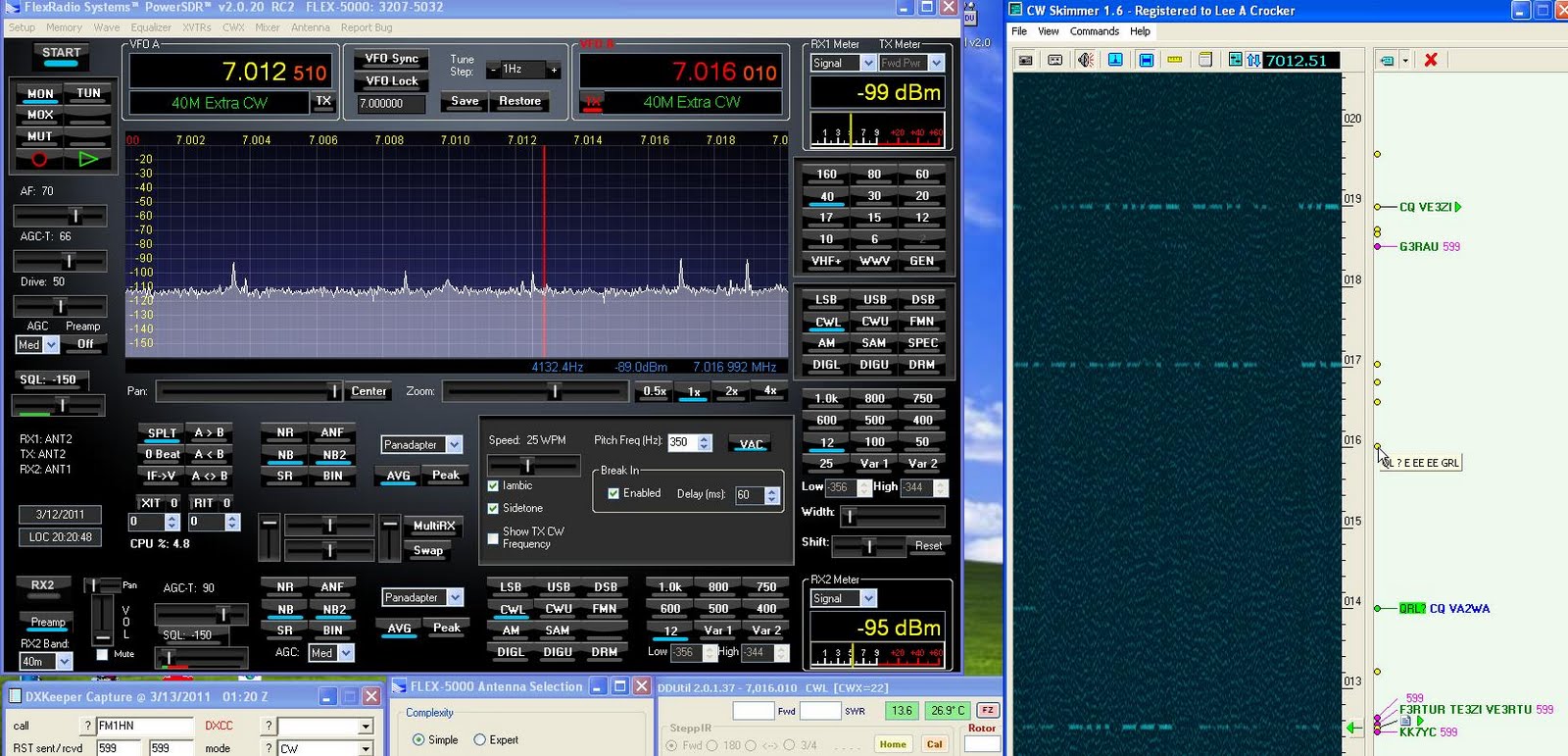
I normally have 4 programs active PSDR DXlab suite CW Skimmer and DDUTIL

You can see that DX lab has several active sub programs Commander, which is the I/O control program, DXView and DXView Map which shows a lot of data about a given callsign and prefix, including things like location short and long path distance and beam headings etc. The map is populated by stations heard by the cluster client Spot collector. Below PSDR I have several windows open The first is the logbook DX Keeper entry window If I click an entry on Spot Collector that callsign and country information as well. If you look at the pic you will see I clicked 9M2TO who was spotted on 30M. You can see the freq and mode was entered into commander and this was transmitted to my radio which switched to 30M, the 9M2TO was entered into the log book entry window, in DX view you see all the relevant data about West Malaysia. You can see I've worked 9M2 on 160 but I do not have them on 30M You can see the path both short and long on the Map and you can see the terminator. My antenna also switched to 30M and I am ready to call him except I don't hear diddly.
Next to the log book entry screen is a mini-window view of DDUTIL. DDUTIL has a memory feature Steve and I designed a while ago that I use all the time. It allows you to memorize up to 5 freqs including mode data filters etc It also has a feature that allows you to annotate the station associated with that freq

Voila'

Note the 9M2TO in the title bar. With this feature I can store up to 5 pile ups and as things wax and wane I can immediately switch between pileups and I can know what pileup I am listening to. Last night I worked FR5ZL on Reunion and he was puny weak, but the terminator was heading his way and I knew he was going to peak soon so I worked another 5 or so DX stations with his freq loaded into memory, checking back every few minutes to monitor the situation. He was working simplex and no pileup because hardly anyone was hearing him. Finally as the terminator flew over his head he peaked and he was in my log. I next switched to 3B8CF on Mauritius who was also in my memory a little farther down the band and worked him

The 3B8 was a LOT stronger than the FR5 station I also access many of my Macros from this screen. It is how I one touch turn diversity on and off and once touch tune up my diversity antenna etc. Below that is a window that is connected to a new device that is a tuning knob for the Flex series of radios

I'm not quite ready to blog about this but soon. It allows control of the VFO's in the radio and up to 9 different functions in the radio, AND IS INDEPENDENT OF SCREEN FOCUS. This means I can be in another program, like a browser and control the volume in the Flex. It also means I can call up the memories in CWX the keyer applet and actually use it as a memory keyer without having to click all over the damn screen. Excellent for DXing. As you can see I have my callsign 5NN and TU programmed, pretty much all you need. There are many other features and when I am ready I will give a full account.
Finally I have Skimmer open with its new TX freq control!!
During contests I use N1MM and generally turn Skimmer and parts of DX lab suite like spot collector off. I keep the log book DX Keeper turned on in case I work a new one
I don't use MIXw at all but I included that so one can see how extra programs can be included in the mix.
Steve K5FR generously makes VSPmanager available to hams who need virtual serial ports. He bought the license for us. Just one of the many things Steve has done to change the face of ham radio. There are other virtual port programs but we have available THE BEST in my opinion thanks to Steve
Here is a shot of how I do VSPmanager
I have 4 physical ports enumerated on my computer. These are on the motherboard or exist as part of a USB to serial port. For example my WinKey USB enumerates as com 3 and I use a USB to serial port (com 5) as the means to get data from my keyers output into PSDR. This allows me to control winkey from programs like N1MM and WinWarbler and allows my keyer to cause the radio to transmit. I also use a USB to serial to get VFO changing data into N1MM when running SO2R. There are other ways to do this, but in my setup this works best for me. I have a second paddle connected to the radios internal keyer so changing keyers for me is a matter of moving my hand from one paddle to the other.

My virtual port setup looks like this

I use pairs that are enumerated in a +10 format, s0 pairs look like 6-16, 7-17, 8-18 etc. Since I have a physical port 9 I do not have a virtual pair 9-19. Some programs like N1MM and DX Lab only allow certain pairs to be used. N1MM can go up to 8

Commander can to up to 16

WinWarbler only allows 16

Skimmer is more liberal and allows up to 20

PSDR and DDUTIL allow anything

The reason I use the +10 method is because I can choose the lower number on virtually any program and then connect it to DDUTIL. If I used serial numbers like 6-7, 7-8 etc I would soon run out of numbers to use. Also it's easy to remember.
Each line between DDUTIL and a program or between PSDR and WinWarbler represents one of these virtual serial ports. I have to use a line between WW and PSDR to control the PTT and switch TX/RX otherwise all the traffic flows through DDUTIL.
All of the programs in the DX lab suite are controlled by commander (except for that PTT) So once you get data into commander it will distribute it as needed for example it will load band freq and callsign data from Spot Collector into DX Keeper and commander and commander will then load band freq and mode data to DDUTIL which will then distribute it to PSDR and Skimmer and what ever else you have running It all works very well.
In keeping with our discussion of Freq Entry, here is how N1MM acts as a method of freq entry

N1MM has its own cluster client built in and will populate a "band map" with call signs on what ever band is selected in VFO's A and B. With the F5K and both receivers active I can therefore work SO2R even though its only one radio. To change freq all I have to do is click either band map and the freq of the corresponding VFO will change. It will also change the transmitter to that VFO so you are then ready to make a contact once again all point and shoot and automatic. The antennas and amp will follow the transmitter so everything will be ready at the touch of a mouse.
Also lets look at WinWarbler

As you can see PSDR is in DIGIU mode and has a wide bandwidth (3750 hz) filter selected. Win Warbler works by switching a narrow bandwidth filter up and down within this 3750 hz window. By moving this filter around in the 3750hz bandwidth you are effectively tuning the radio in a virtual kind of way. As you can see WW will allow you to have 3 separate filters tuning around the bandwidth so you can listen and work up to 3 stations simultaneously.
Actually you can listen to up to 47 QSO using a Stations Heard screen and a channel monitor screen which decodes all the activity in the 3750hz window

This thing really gets hopping when the band is open!! I'm not a big user of digital modes but for those of you who enjoy or would like to experiment this set up works great. It gives you a tone of modes to use as well not just PSK31

It also has a digital voice keyer built in but I have never played with that. I'm a CW guy.
73


 As you can see by comparing the plots below the S21 and the VU4 are on the exact beam heading so if they are still there I have a chance of working either or both just around my sunset and through the hour of shared darkness until their sunrise